Client
Services
- Web-Development
- Artificial Intelligence
- Drupal
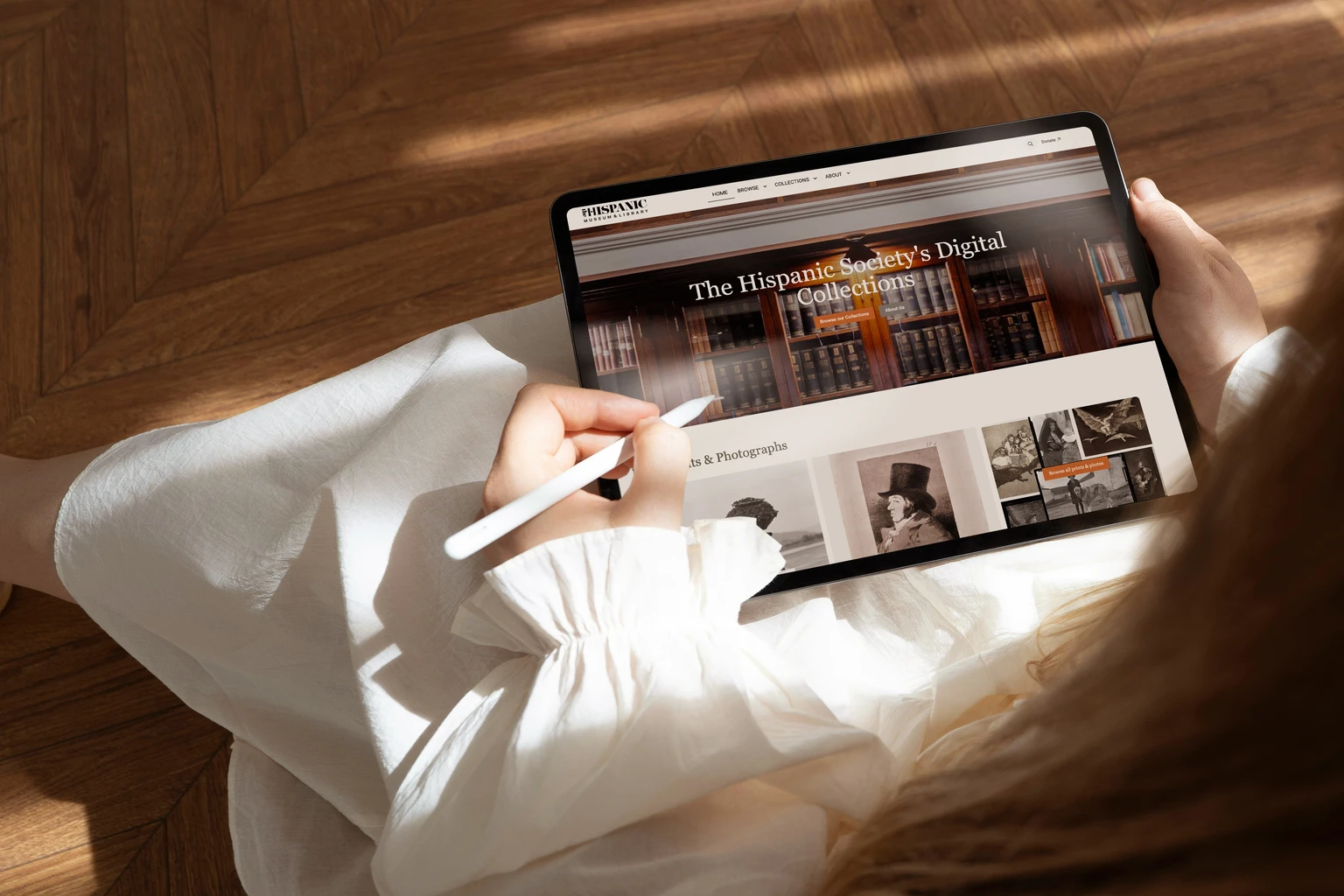
The Hispanic Society's Digital Collections
Five centuries of Hispanic art, manuscripts and photography — now open to the world.
- Client: The Hispanic Society Museum & Library, New York City
- Live: diglib.hispanicsociety.org
- Stack: Drupal, Archipelago Commons, IIIF (Cantaloupe), S3 object storage (EU), Solr
- Scope: Digital repository architecture, preservation-grade asset pipeline, IIIF delivery, EU-hosted & GDPR-compliant, high-volume ingest
A collection without equal — outside Spain
Founded in New York in 1904 by Archer Milton Huntington, the Hispanic Society of America was conceived as a free public museum and reference library dedicated to the art and culture of Spain, Portugal, Latin America and the Philippines. More than a century later, it holds what is widely considered the most comprehensive collection of Hispanic art and literature outside Spain itself.
The numbers are staggering. Paintings by El Greco, Velázquez, Goya and Sorolla — including Sorolla's monumental fourteen-canvas Vision of Spain, more than 200 feet of painting ringing a single gallery. A rare-books and manuscripts department with more than 250,000 manuscripts, documents and letters spanning the 11th to the 20th centuries, some 250 incunabula, a first edition of Don Quijote, and one of the few surviving Black Books of Hours. Alongside them: roughly 175,000 photographs, thousands of drawings, prints, textiles, ceramics and sculpture.
Much of this material is unique, fragile and — until now — accessible only to researchers who could travel to Audubon Terrace in Upper Manhattan and request an appointment.
Why it matters
A privilegio issued by a 12th-century king of Castile. Ruth Matilda Anderson's ethnographic photographs of rural Spain in the 1920s. Sailing charts from the Age of Exploration. These are primary sources for the history of the entire Hispanic world — and every year they can only be handled a finite number of times before conservation concerns close them off.
Digitisation changes the arithmetic completely. A single high-resolution capture, delivered well, means a scholar in Buenos Aires, Manila or Madrid can study a manuscript in detail that would be impossible to grant in person — while the original stays safely in its climate-controlled vault. Open cultural heritage isn't a nice-to-have for an institution like this; it's the mission itself, extended to a global audience.
The Hispanic Society came to us to build the platform that would make that possible.
The brief
Take an extraordinary, deeply heterogeneous body of material — illuminated manuscripts, oversized maps, glass-plate photography, bound volumes, works on paper — and put it online in a way that is:
- Faithful — image quality high enough to serve serious scholarship, with true deep-zoom down to the brushstroke and the watermark.
- Durable — a preservation-grade storage layer that treats the digital surrogate as an asset to be kept for decades, not a thumbnail to be regenerated.
- Interoperable — built on open standards so the collection can travel: embedded in exhibitions, cited by researchers, and shared across institutions.
- Scalable — able to grow from a handful of curated collections to a vast archive as digitisation continues, without re-architecting the platform for each new wave of material.
- Compliant — hosted in European data centres and GDPR-compliant end to end, matching the EU and Spanish-speaking audiences the collection serves.
- Sustainable — running on open-source foundations the institution actually owns, with no lock-in to a proprietary black box.
What we built
At the heart of the platform is Archipelago Commons running on Drupal — the open-source digital-objects repository framework that has become the reference architecture for standards-based cultural collections. As a preferred Archipelago vendor, this is the terrain we know best, and the Hispanic Society's collection is exactly the kind of complex, high-value material Archipelago was designed for.
The archive launched with a focused set of flagship collections — Anderson Photographs, Prints by Goya, Primeros Libros de las Américas and Spanish Philippines Manuscripts — and was built from day one to grow. As the Hispanic Society's digitisation programme accelerates, large volumes of new material flow into the same pipeline: batch-ingested, consistently described, and immediately discoverable. The platform was never scoped to a fixed set of objects; it was scoped to keep absorbing them.
Every object — regardless of type — is modelled as a rich, flexible metadata record and paired with one or more digital files held in S3 object storage. That separation of metadata from bytes is deliberate: it means the descriptive record can evolve, the same master file can drive many derivatives, and the underlying storage can scale without ever touching the catalogue.
From those masters, the platform serves imagery through IIIF — the International Image Interoperability Framework — via a Cantaloupe image server. In practice that means tile-based, on-the-fly delivery: a reader opens a Goya drawing and can zoom smoothly from the full sheet down to individual pen strokes, panning across a 24-foot Sorolla sketch as if standing in front of it, all without downloading a single enormous file.
The bells and whistles
- True deep-zoom viewing — OpenSeadragon and Mirador viewers driven by the IIIF Image API, so oversized maps, murals and manuscripts are explorable in fine detail directly in the browser.
- IIIF interoperability — because every object exposes a standard IIIF manifest, the collection can be embedded, compared side-by-side, and consumed by any IIIF-compliant tool in the wider scholarly ecosystem.
- S3 preservation storage in Europe — masters held in resilient object-storage buckets in European data centres, GDPR-compliant, with checksums and fixity in mind, keeping the digital originals safe and independent of the presentation layer.
- Flexible, standards-aware metadata — Archipelago's JSON-based metadata model handles everything from a single photograph to a multi-volume bound manuscript without forcing wildly different materials into one rigid schema.
- Faceted, full-text discovery — Solr-powered search lets researchers narrow across collection, date, medium, creator and more, and surface material that was previously findable only by knowing it existed.
- Built for high-volume ingest — batch pipelines carry the archive from a handful of curated sets to massive scale, adding new material continuously without re-engineering the platform.
- Multi-format ready — one pipeline for images, documents, audio, video and beyond, so the platform grows with the digitisation programme rather than being rebuilt for each new material type.
Hosted in Europe, compliant by design
The Hispanic Society's collection speaks most directly to audiences in Spain and across the EU, so the platform is hosted accordingly. Digital masters and derivatives live in object-storage buckets in European data centres, and the stack is GDPR-compliant end to end. For an institution serving European researchers and the Spanish-speaking world, data protection and jurisdiction aren't an afterthought — they're part of the architecture.
Under the hood
| Layer | Technology |
|---|---|
| Repository framework | Archipelago Commons on Drupal |
| Object storage | S3 object storage — European data centres, GDPR-compliant |
| IIIF image server | Cantaloupe |
| Deep-zoom viewers | OpenSeadragon, Mirador |
| Search & discovery | Apache Solr |
| Delivery | IIIF Image & Presentation APIs |
Open standards, open source, institution-owned, EU-hosted — a platform the Hispanic Society controls, can extend, and can trust for the long term.
The outcome
The Hispanic Society's collection is no longer something you have to travel to New York to consult. Scholars, students and the simply curious anywhere in the world can now search the archive, open an object, and zoom into detail that would once have required white gloves and an appointment — while the originals remain untouched in the vault.
For an institution whose founding purpose was free public access to the culture of the Hispanic world, this is that mission carried onto the open web: standards-based, preservation-minded, EU-hosted, and built to last.
Why roromedia
Digital collections at this level are a specialist discipline. Archipelago, IIIF and preservation-grade asset pipelines aren't generic web work — they demand a partner who lives in this ecosystem. As a preferred Archipelago vendor and long-standing Drupal contributor, roromedia builds cultural-heritage platforms that hold up to scholarly scrutiny and stand the test of time.
Have a collection that deserves to be seen? Let's talk.
Additional Latest works

Rebranding Allerstorfer Elektroanlagen GmbH
Allerstorfer Elektroanlagen GmbH, a leading electrical services provider, approached our design agency with the objective of rebranding their company image to better align with their commitment to exceptional customer service and cutting-edge solutions.
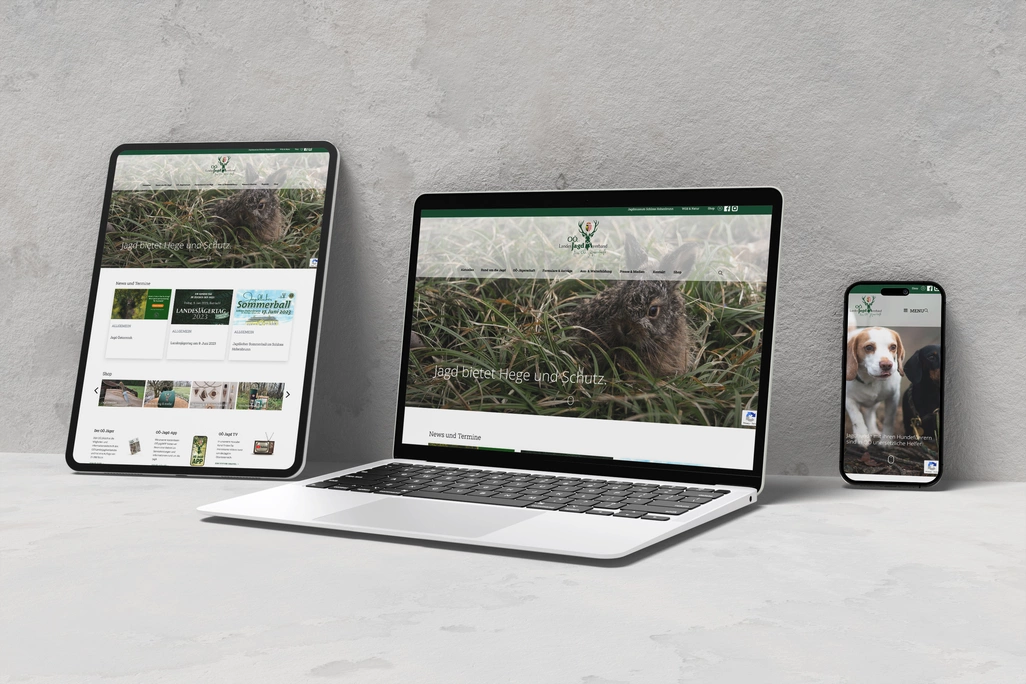
Redesign and development for the Upper Austrian federal state hunters' association
The Hunters Association of Upper Austria is a prominent organization with a membership base of over 10,000 avid hunters.